

Sections
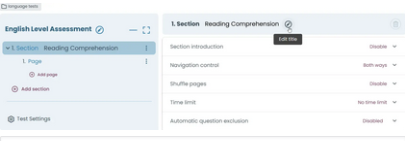
Section Settings let you configure how a section behaves during the test. You can control flow, timing, display options, and apply restrictions for each section.
Each setting controls a different part of the section behavior. Here are the available settings and what they do:
QUICK SUMMARY
| Setting | Purpose |
| Section introduction | Shows an introduction message before the section starts |
| Navigation control | Controls how candidates move between pages |
| Shuffle pages | Randomizes the order of pages in the section |
| Time limit | Sets a time restriction for the section |
| Automatic question exclusion | Automatically removes a set number of questions |
1. Section Introduction
This option allows you to show an introduction or instructions before the section begins.
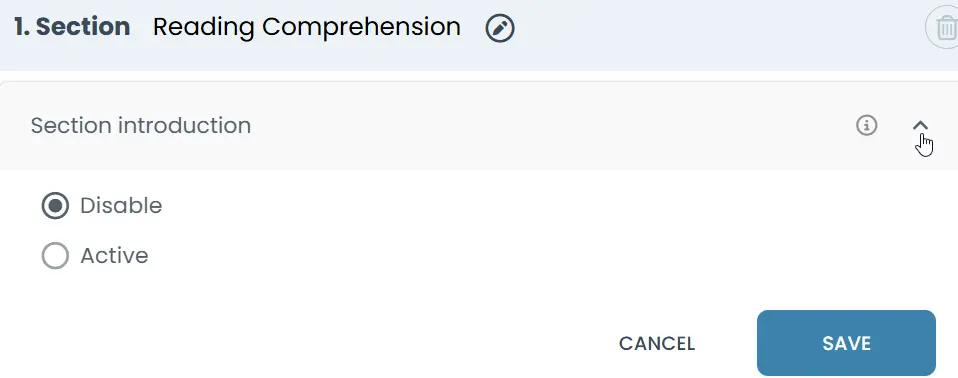
- If disabled, candidates start the section immediately.
- If enabled, you can add instructions such as:
"Please read each question carefully before answering."
This is useful when you want to:
- give instructions
- explain the type of questions
- provide important information before the section starts
2. Navigation Control
Navigation control determines how candidates can move between pages within a section.
It allows test creators to control whether candidates can review previous pages, move forward freely, or stay locked on the current page.
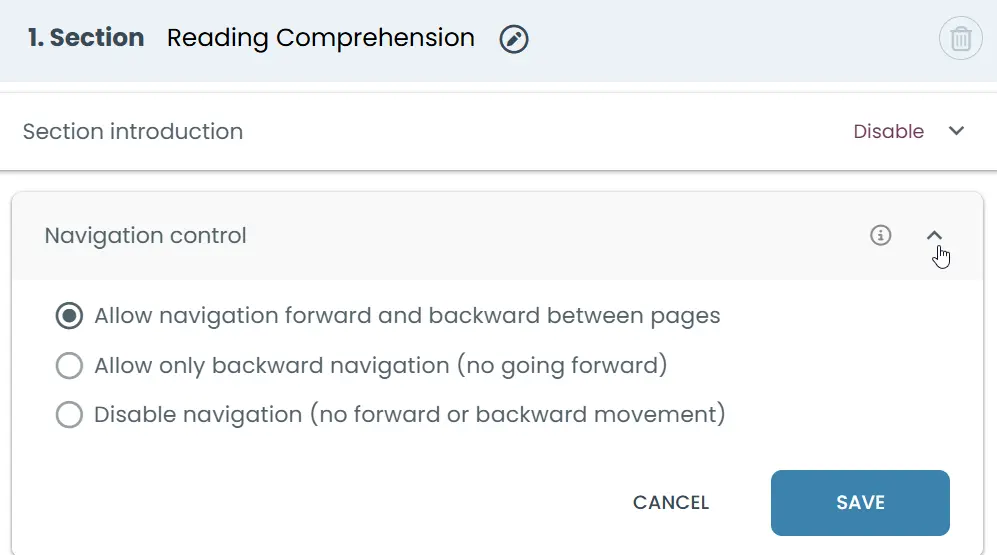
2.1. Allow navigation forward and backward between pages
Candidates can move freely between pages.
They can go forward, go back, and change their answers.
Why use it
- When answers may need review
- When flexibility is required
- Common in writing tests and surveys
2.2. Allow only backward navigation (no going forward)
Candidates can go back, but cannot move forward again after leaving a page.
Example:
Page 1 → Page 2 → Back to Page 1 → Cannot return to Page 2
Why use it
- To prevent previewing upcoming questions
- To control test progression
- When answers should not depend on later questions
2.3. Disable navigation (no forward or backward movement)
Candidates cannot move between pages freely.
They cannot return once they continue.
Why use it
- To enforce strict test flow
- To prevent changing answers
- Common in secure or proctored tests
3. Shuffle Pages
This option controls whether pages appear in random order.
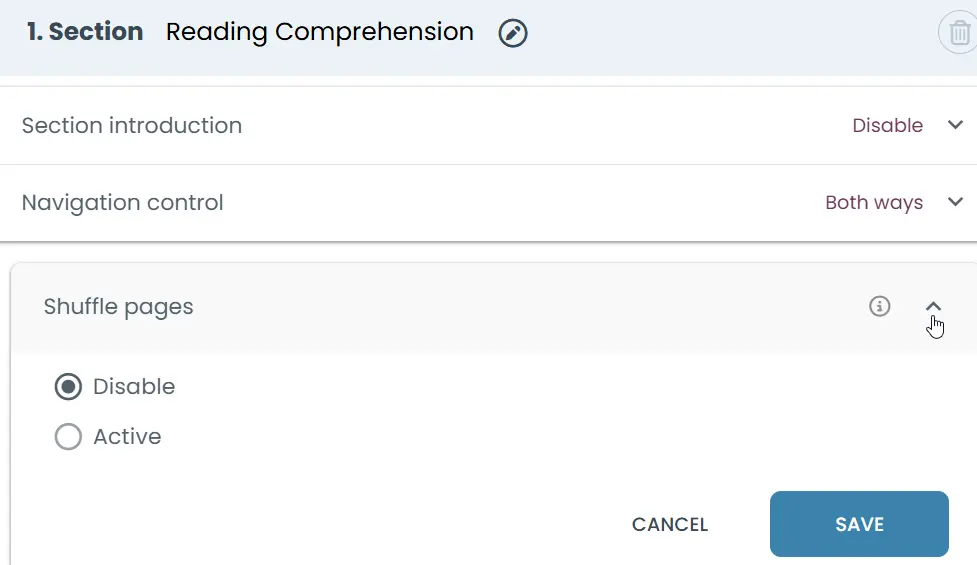
- If disabled, pages appear in the same order they were created.
- If enabled, the system randomizes the order of pages for each candidate.
3.1. Time Limit
This setting defines how long candidates have to complete the section.
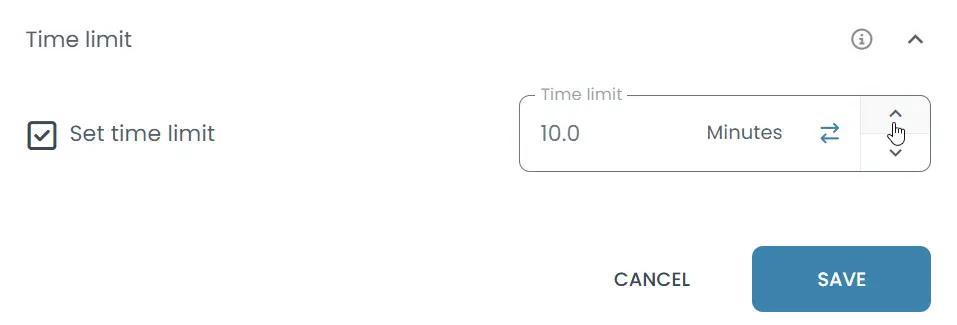
- If no limit is set, the section follows the overall time limit defined for the test, which will be determined later when configuring the test settings.
- If a time limit is added (for example, 15 minutes), candidates must finish the section before the time runs out.
Why use it
- When evaluating speed and accuracy
- To ensure time-based evaluation
- Common in timed assessments and exams
4. Automatic Question Exclusion
This feature allows candidates to answer a required number of questions from a larger set.
Instead of answering every question, candidates choose which questions to answer.
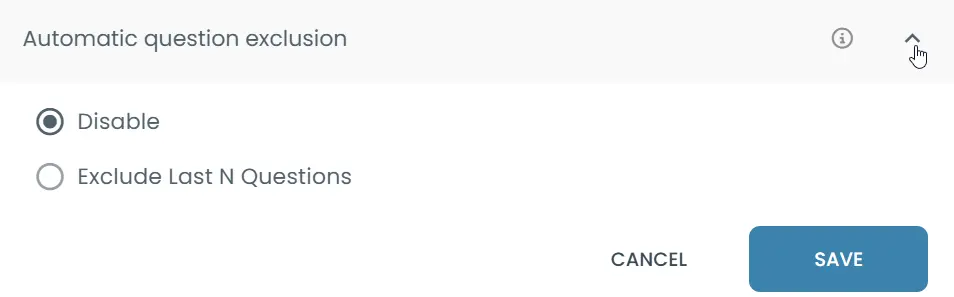
Example instruction:
Answer 3 of 5 questions:
- 5 questions are available
- The candidate must answer any 3
- 2 questions can be skipped
Why this feature exists
- Ensuring fairness among candidates: Candidates can choose questions based on their level.
- Allowing topic choice: Candidates answer questions they are more comfortable with.
- Providing alternative questions for the same skill: Different questions measure the same ability in different ways.
Example:
A section includes 10 questions. Candidates must answer 4.
They choose which questions to answer.
Important:
- Candidates must answer at least N questions
- Extra answers may not be counted
- Instructions should clearly state how many questions to answer