

Getting started Product Tour Question Bank Question Types Test Editor Grading and Evaluation Lockdown Browser Online Proctoring
Organization management Setting Up Your Organization General Settings Configuring Consent Process Branding Plans & Credits Understanding Subscription Plans Managing Credits Changing Subscription Plans Billing Settings Credit Notifications Users and Collaboration Roles and Permissions Adding New Users & Assigning Roles Importing Users Organizing Users into Teams Advanced Permissions & Access Control User Login Controls Monetization
Question Bank Creating a Question Adding Image Adding Audio Adding Video Adding File Editing Layout Adding Feedback Adding Hint Math Input Importing Questions Question Reporting Scoring Question Types Multiple Choice Questions Matching Questions Text-Based Questions Rich Content Questions Numeric Questions Coding Questions Audio Recording Video Recording Photo Capture File Upload Fill-in-a-Table Questions Organizing Questions Folders and tags Batch update Schema Browsing Questions Exporting Questions Presets Composites
Tests (deprecated) Creating a Test Pages Sections Adding Questions Previewing Test Setting Profile Test Type Test Navigation Time-Limits Auto Numberings Mandatory Question Security Shuffling Deprecated Customize Section Weights Randomization Reporting
Tests Creating a New Test Test Settings Quick Exam Creation Creating Randomized Tests Adding Questions Sections Automatic Question Exclusion Shuffling Pages Time Limit Navigation Control Section Introduction Page Structure Shuffle Questions Time Limit Layout
Tests Page Structure

Random Page Picker

Randomly select pages from a group to show different content to each candidate during the test.

Updated 2026/04/15

This feature lets you vary which pages appear by selecting from a defined group.

What it does

Selects pages randomly during the test.

Example:

You add 3 pages and set it to show 1.

Result:

Each candidate sees a different page.

How it works (manual setup)

- Pages must be manually added and grouped for selection.

- The system does not create or assign pages automatically.

Why to use it

  • Helps reduce predictability by varying page content.
    • Allows you to create multiple versions of the same section.
      • Improves test fairness by limiting content sharing between candidates.
        • Keeps the test experience more dynamic and less repetitive.

          How to Set Up Random Page Picker in 4 Steps

          STEP 1

          Open the Add page menu and select Random Page Picker.
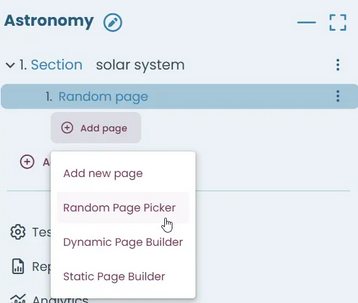
          Open the Add page menu and select Random Page Picker to create a page with randomized alternatives.
          Open the Add page menu and select Random Page Picker to create a page with randomized alternatives.

          STEP 2

          Click Add Alternative Page to create the pages that will be used as alternatives.
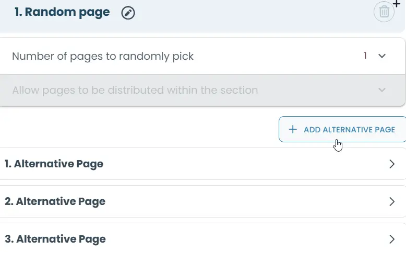
          Add alternative pages, then select how many will be randomly shown during the test.
          Add alternative pages, then select how many will be randomly shown during the test.


          STEP 3

          Set the number of pages to randomly pick, then click Save.
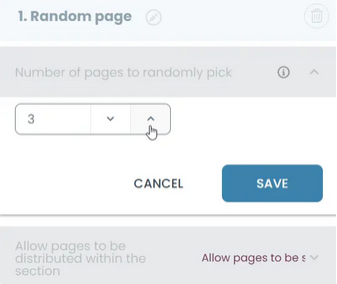
          Set how many pages will be randomly selected, then click Save to apply and continue.
          Set how many pages will be randomly selected, then click Save to apply and continue.

          STEP 4

          Choose whether the selected pages should stay together or be distributed within the section.
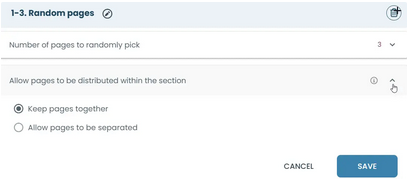
          After saving the number of pages, choose whether selected pages stay together or are distributed across the section.
          After saving the number of pages, choose whether selected pages stay together or are distributed across the section.

          Allow Pages to Be Distributed Within the Section

          This setting controls how the selected random pages are placed within the section.

          1. Keep pages together

          Selected pages appear as a single block.

          Example:

          You select 3 pages.

          Result:

          They appear one after another without interruption.

          2. Allow pages to be separated

          Selected pages can be spread across the section.

          Example:

          You select 3 pages.

          Result:

          They may appear in different positions, mixed with other pages.

          Go back