
How to create a coding test
Lesson objective
Create coding tests online to assess developers with real-world tasks. Choose from 40+ programming languages, customize your test structure, and evaluate submissions with rubrics, manual scoring, or AI-powered review.
Design interactive, language-specific coding tests that measure real-world programming skills in a secure and flexible environment.
With TestInvite, you can build coding assessments that evaluate logic, syntax, structure, and problem-solving ability, all within a customizable editor that supports over 40 programming and scripting languages.
What is a coding test?
A coding test is an assessment where candidates write and submit code to solve specific programming tasks. These tests are commonly used in technical hiring, developer training, and academic evaluations.
TestInvite’s coding questions allow test-takers to respond inside an embedded code editor — supporting real syntax highlighting and developer-friendly interactions.
Coding tests help assess algorithmic thinking, practical coding ability, and familiarity with the syntax and structure of specific languages. They simulate on-the-job challenges by prompting users to implement functions, manipulate data, or build logic from scratch.
Create coding tests with ease
Creating a coding test with TestInvite’s exam tool is fast and flexible. Navigate to the Tests module, create a new test, and give it a name. Sections and pages are generated automatically, so you can begin adding your coding questions right away.
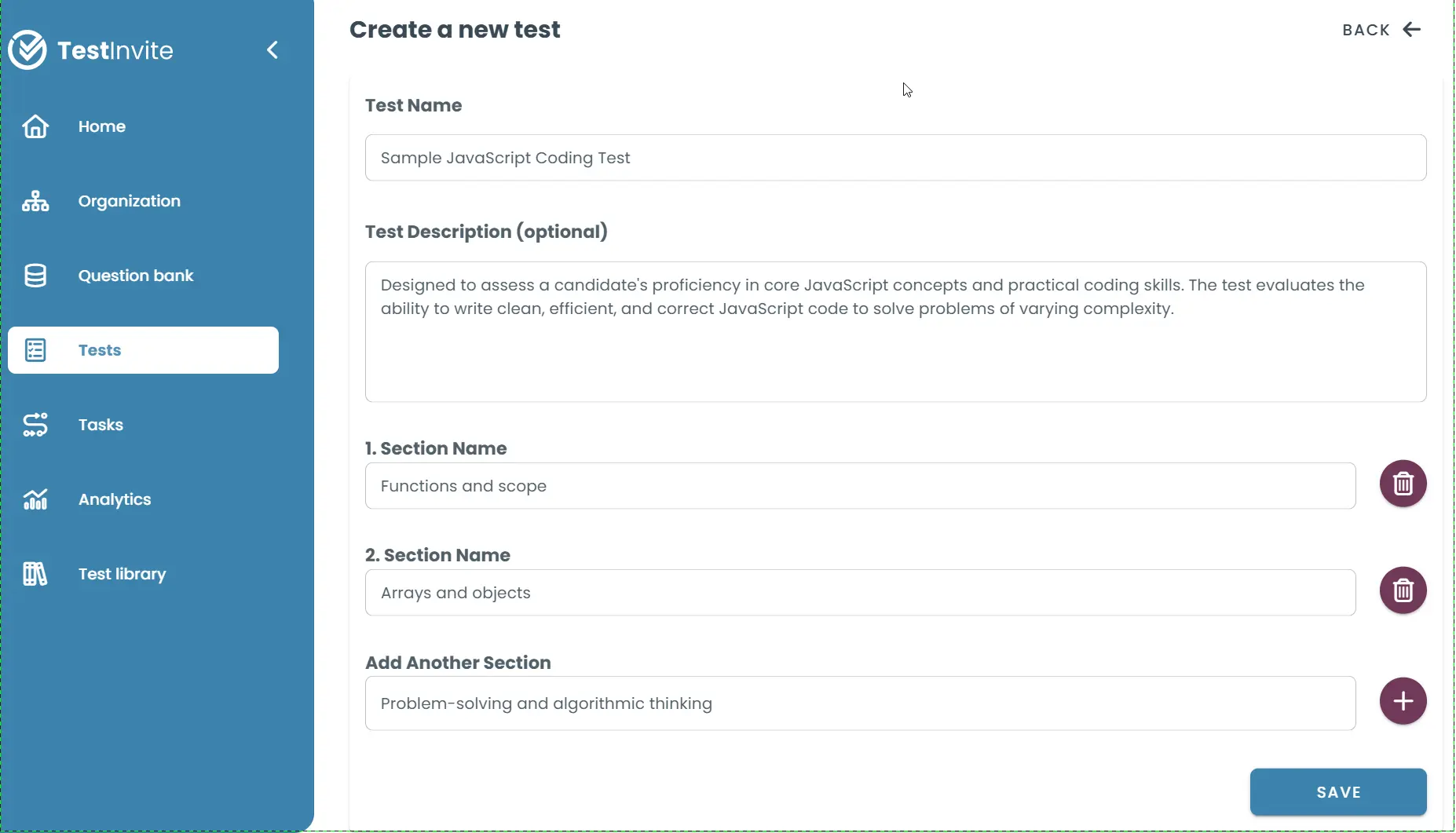
Each section can focus on a different topic like functions, data structures, or algorithms, and you can structure pages to group related problems. Whether you're testing fundamentals or advanced logic, the platform adapts to your structure.
Design real-world coding challenges
TestInvite’s Coding question type enables you to prompt candidates with programming tasks and let them write code directly in the browser.
You can configure:
- Programming language: Select from 40+ supported languages, including JavaScript, Python, Java, C++, HTML, SQL, Go, PHP, Swift, and more. The editor updates to support syntax highlighting and formatting based on your choice.
- Initial code: Pre-fill the editor with function headers, templates, and instructional comments or leave it blank to challenge candidates with a clean slate.
- Prompt and structure: Use the rich text editor to write detailed instructions, add formatting, or insert reference materials. Candidates will see your prompt alongside the editor.
- Editor tools: Test-takers can undo/redo, adjust indentation, toggle light/dark mode, and expand the editor as needed.
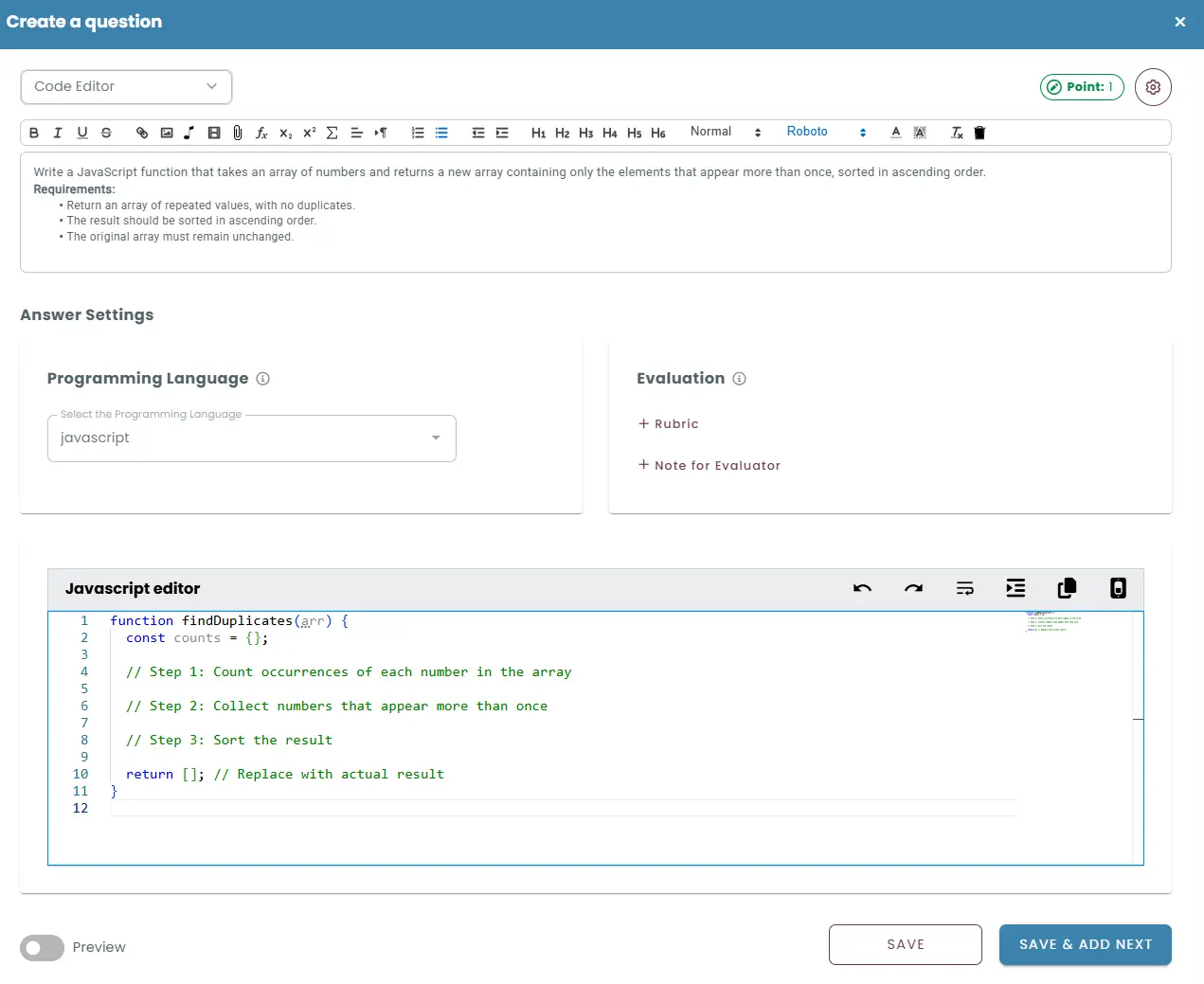
Whether you’re testing algorithmic efficiency or front-end markup, the editor supports a smooth, test-taker-friendly experience.
Evaluate code with flexibility
TestInvite supports distinct evaluation methods for coding questions, allowing you to match the review process to your goals. Choose the best evaluation method per question or mix all three depending on the complexity of the task:
1. Manual evaluation
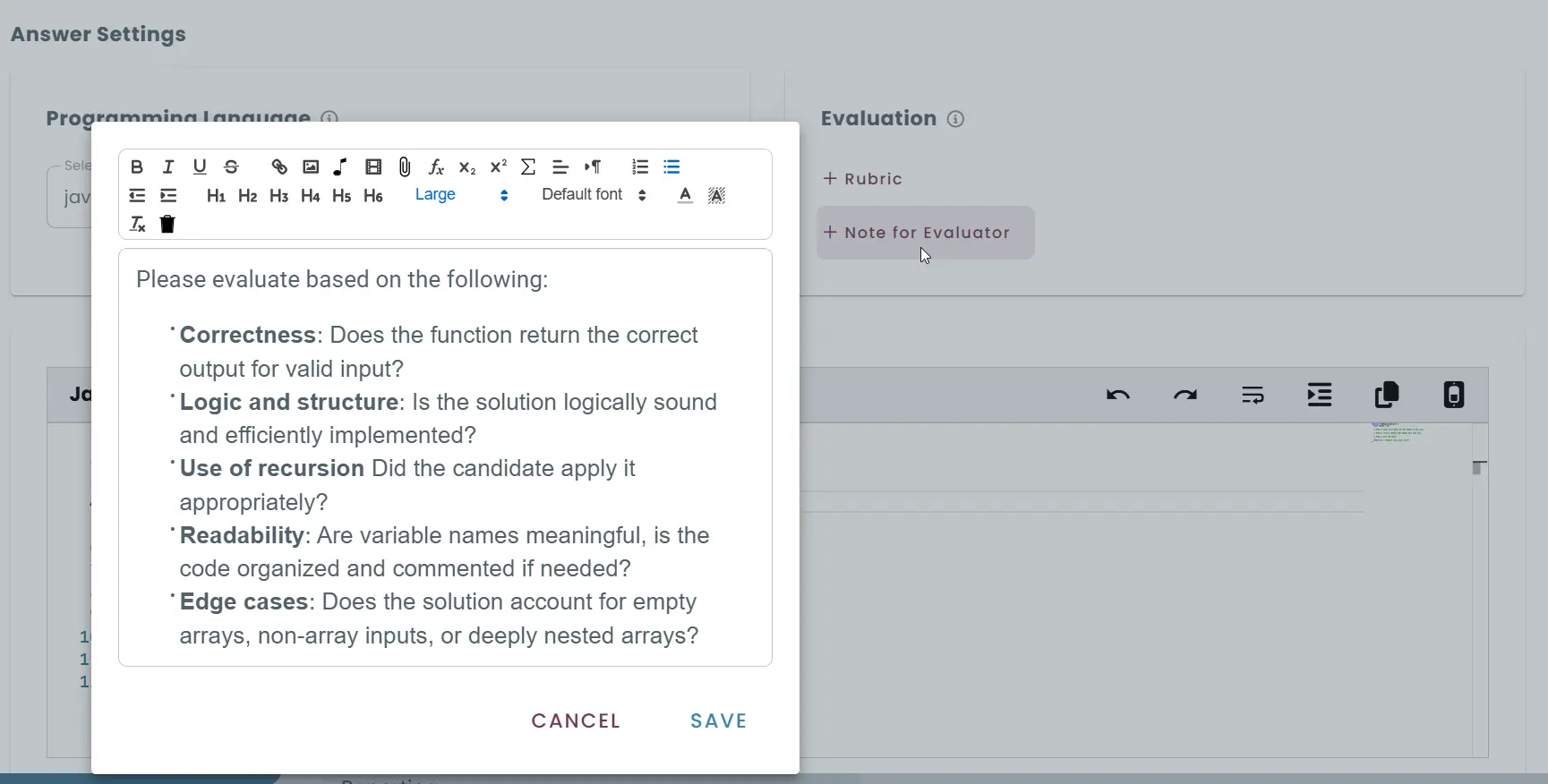
For full control, evaluators can read submitted code and assign points directly according to a predefined note for the evaluator. This is ideal when solutions vary in structure or require subjective judgment.
2. Rubric-based evaluation
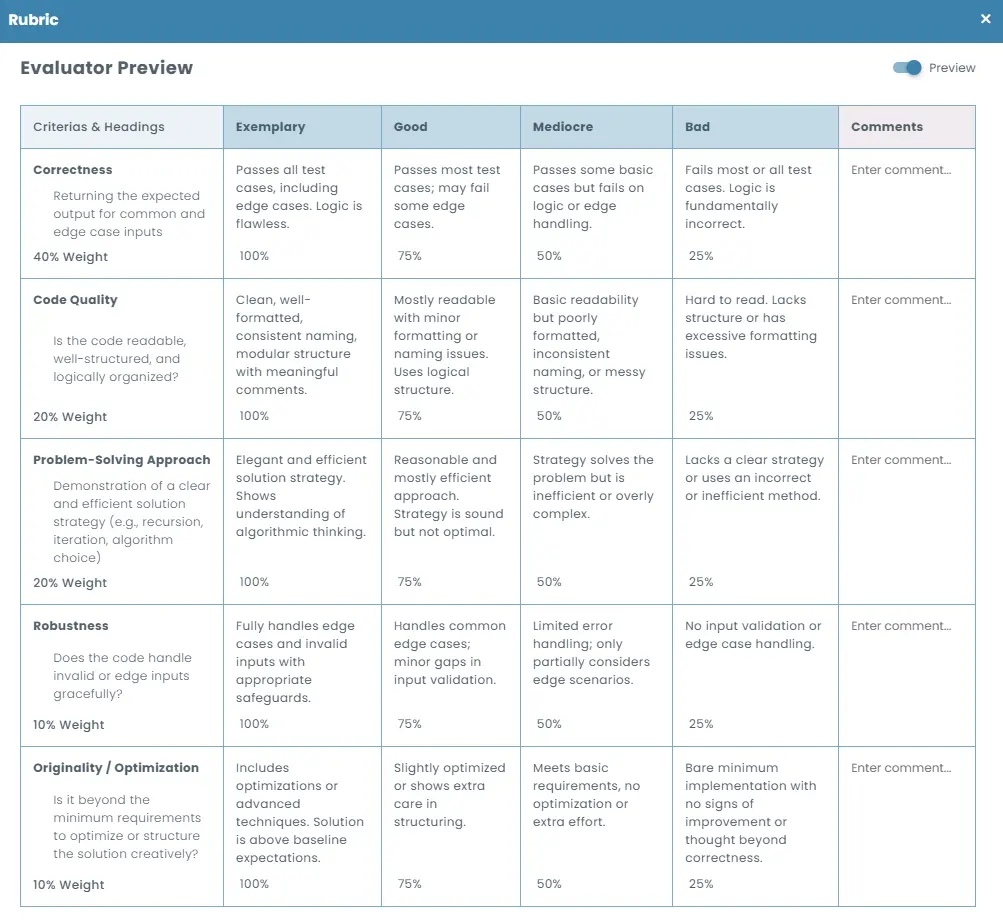
Attach a scoring rubric to define criteria such as logic, syntax, readability, efficiency, or code structure.
Rubrics help standardize how partial credit is awarded, even when code isn’t 100% functional. Perfect when you want to reward strong reasoning or clean design.
3. AI-powered evaluation
Use AI to grade questions and generate a suggested score, which is a great approach for scaling manual review, especially when combined with evaluator confirmation or review notes. Define evaluation criteria in your prompt (e.g., correctness, edge case handling, comments) and let the system assist your review team.
Secure and structured coding test delivery
TestInvite ensures that coding tests are delivered with the same level of control, security, and structure as all other exam types on the platform. Whether you're assessing developers remotely or in a high-stakes setting, you have full control over how the test behaves and how securely it runs:
- Time Limits: Set strict time constraints for the entire test or apply specific timers at the section and page level to manage pacing.
- Navigation Control: Prevent skipping or backtracking by enforcing linear navigation, ensuring candidates complete tasks in a fixed sequence.
- Proctoring & Lockdown: Enable webcam monitoring, screen recording, and browser lockdown to prevent unauthorized access, external assistance, or multitasking during the exam.
- Access Restrictions: Secure the exam environment with invitation-only access, login credentials, or PIN-based entry to control who can take the test.
- Randomized Delivery: Shuffle questions or entire pages to deliver a unique version of the test to each candidate, reducing the risk of collaboration or content leakage.
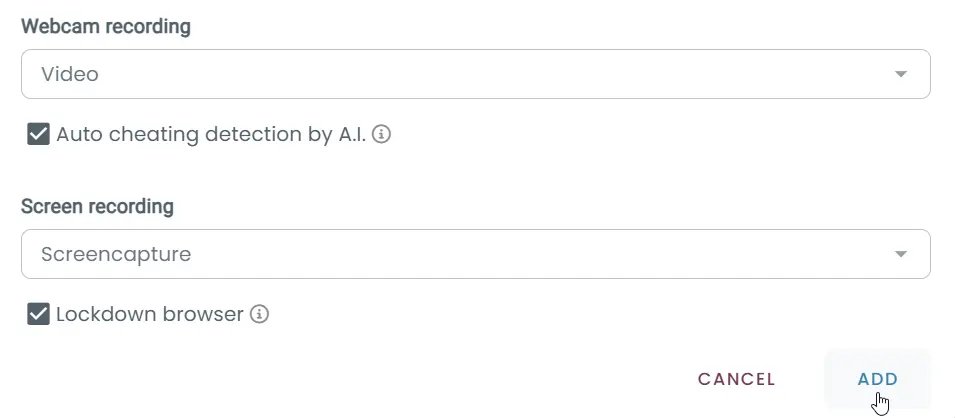
With these layered protections, your coding assessments remain fair, secure, and reliable, even at scale.
When to use coding tests
Coding assessments are a powerful tool for:
- Technical hiring for software development roles
- Programming courses and bootcamps
- IT certifications and technical skills validation
- Evaluating problem-solving in real-world scenarios
Reliable coding assessments, built for performance
TestInvite makes it easy to deliver coding tests that are structured, secure, and scalable:
- Create language-specific, real-world programming tasks
- Evaluate with rubrics, AI, or manual review
- Analyze detailed results and track performance over time
- Ensure integrity with built-in proctoring and browser lockdown
- Offer a smooth coding experience on any device
Whether you're testing 10 developers or 10,000, TestInvite gives you the tools to create and manage high-quality coding assessments from end to end.